

Within our innovative line of R&D in Natural Defensive Biotechnology , we have developed an initiative focused on finding alternatives to some of the controversial inputs permitted in both conventional and organic agriculture for pest and disease control , including copper-based fungicides, mineral oils and sulfur.
Cultifort offers a range of alternative and/or complementary products to replace or reduce treatments based on formulations with copper, mineral oils, sulfur, or their derivatives, in the control of pests and diseases, both in woody and herbaceous crops, as well as in horticultural crops.

Alternatives for the gradual elimination of controversial inputs in agriculture
The proposed alternatives should not be considered mere substitutions of one input for another, but rather incorporated into broader, integrated strategies . In general, crop health will rely on preventive and indirect management measures , which are preferable to the use of externally sourced inputs. The selection of varieties adapted to local conditions, plant resistances, the alternation of active ingredients, crop rotations, the promotion of biodiversity, and other cultural practices that ensure a resilient agroecosystem will greatly contribute to reducing dependence on external inputs.
Control of pathogens (including certain pests) that affect and cause damage to plant tissues in the aerial part of plants is carried out primarily by regular spraying with products formulated with copper, mineral oils, and sulfur.
The harmful effects of copper on microbial communities and other soil fauna (due to drift) have led to European Union regulations restricting its use. The use of copper for plant protection purposes was authorized in the EU at up to 6 kg/ha/year of metallic copper until the end of 2018, and this limit was reduced to 4 kg/ha/year from January 2019. According to information obtained through consultations and interviews with experienced technicians and farmers, the 4 kg/ha/year limit seems acceptable to most, except in exceptional cases where certain endemic pests and diseases require exhaustive and continuous control because soil and climatic conditions favor a higher incidence of these pests and diseases.
Numerous alternative compounds are being developed to reduce or replace copper inputs, but their use is poorly implemented.

WHAT ARE THE ALTERNATIVES TO CONTROVERSIAL INPUTS IN AGRICULTURE?
ALTERNATIVES TO COPPER
- Formulations with low copper content, with percentages between 2 and 6%, allow applications with lower copper inputs per hectare.
- Natural formulations, applied to replace or reduce current copper doses, used alternatively or in combination with copper. Some of them are included in Annex II of Commission Regulation (EC) 889/2008, permitted for phytosanitary purposes in organic farming.
- Inorganic substances: Zeolite for spraying and Kaolin against abiotic stresses and protection against biting/sucking insects.
- Natural defense stimulants from plants, including calcium and silicon.
- Biological control agents with various mechanisms of action against phytopathogenic fungi and bacteria and with a stimulating effect on the natural defenses of plants (for example Trichoderma spp.).
- Chitosan, a natural polymer derived from chitin, directly effective against various microorganisms, and stimulating self-defense mechanisms.
- Compost: Compost tea enriched with oriental plantain (Platanus orientalis) leaves, vermicompost and vermicompost tea.
- Calcium polysulfide, Used in spraying to control fungal infections with some effect on insects and bacteria.
ALTERNATIVES TO MINERAL OILS
Mineral oils are applied for the control of insects and mites . Their use ranges from 30-90 liters/ha/year. Their broad spectrum of action makes oils more versatile than other alternatives, which include:
- Organic oils
Zeolite and Kaolin
ALTERNATIVES TO SULFUR
The amount of sulfur applied in agriculture in the Mediterranean basin ranges from 15-20 kg/ha/year. No alternatives currently in use are known.
WHAT PRODUCTS DOES CULTIFORT OFFER AS ALTERNATIVES TO CONTROVERSIAL INPUTS?
CUVIOL PLUS
CUVIOL PLUS combines copper with lignosulfonates and polysaccharides to prevent fungal diseases. It boosts plants' natural defenses and provides copper's antifungal and antibacterial properties . Its formulation stimulates plant growth and corrects copper deficiencies in sensitive species. It is a stable product that is easily absorbed by plants.
Its use is recommended in citrus fruits (especially in the satsuma group because it is sensitive to this deficiency), in herbaceous crops, fruit trees, vegetables, olive trees and vines, both by foliar and root application, and applied throughout the vegetative cycle, especially at times when climatic conditions are favorable to the development of diseases caused by fungi and bacteria.
Product certified for use in organic agriculture (CAAE).

FOLIQUINO
FOLIQUINO is a formulation based on aluminum lignosulfonate , derived from lignosulfonic acid, a naturally occurring complexing agent composed of a low molecular weight polymer. This provides it with a high capacity for penetration and translocation within the plant, both through the leaves and roots, with upward and downward systemic action . It introduces aluminum salts into the plant and promotes the synthesis of natural compounds that improve defense against certain fungal and bacterial pathogens in roots, trunks, branches, leaves, and fruit. Furthermore, it significantly improves sap circulation , enhancing the effect of any product with which it is mixed (synergy).
Thanks to its formulation, it stimulates plant development with the introduction of manganese and zinc, essential microelements directly related to growth.
Product certified for use in organic agriculture (CAAE).

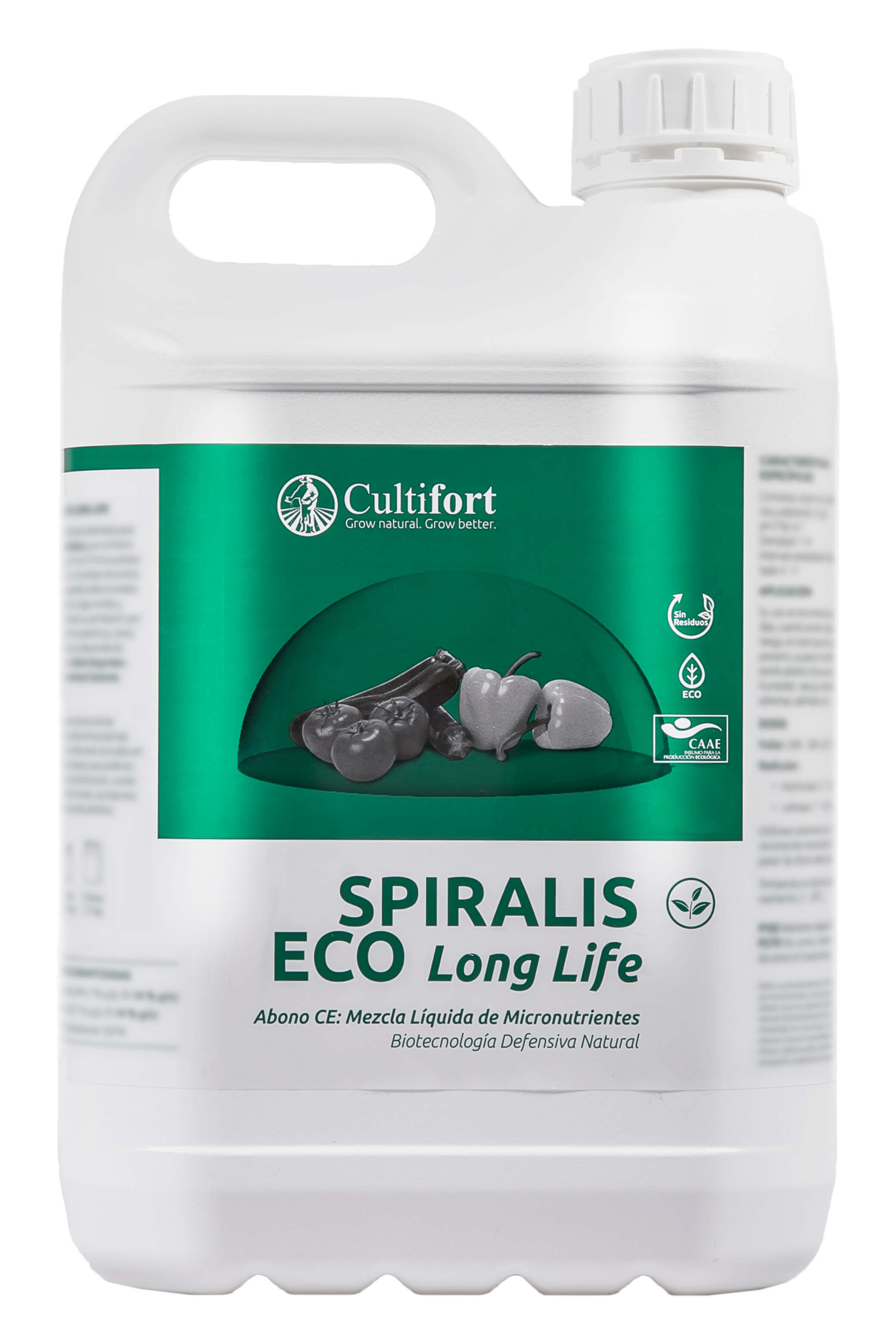
SPIRALIS ECO LONG LIFE
SPIRALIS ECO LONG LIFE is a fertilizer solution containing manganese and zinc in an organic chelated form, along with a complex of organic acids and selected peptides, related to green and red algae , which facilitate its assimilation by the plant and enhance the bioprotective effect against various abiotic stress factors.
SPIRALIS ECO LONG LIFE promotes the induction and facilitates the mobilization of precursors, stored in vacuoles and plastids, of the plant's natural defenses , thereby enhancing the synthesis of endogenous molecules with high defensive capacity and systemic activity . The synthesized endogenous defensive molecules induce structural changes in plant cell walls at the level of lignification, thus constituting a physical barrier against abiotic stress.
Product certified for use in organic agriculture (CAAE).
CULTISAN
CULTISANO is a liquid formulation of chitosan , a natural polymer from the shell of crustaceans, and amino acids derived from the enzymatic hydrolysis of vegetable proteins.
From a nutritional point of view, it stimulates plant development, delays senescence and extends productive life ; it also has a bioprotective function by activating self-defense mechanisms of plants against certain fungi and bacteria.
It has been demonstrated that Preventive action by inhibiting mycelial growth and sporulation in various types of fungi, such as Alternaria spp., Botrytis cinerea, Colletotrichum glosporoides, Fusarium oxysporum, Rhizopus stolonifer y Penicillium spp., and in bacteria of the genus Pseudomonas Plectobacterium y xanthomonas, among others.
It is biodegradable, non-toxic, and bioactive . It strengthens the root system, improves rooting, and increases the plant's resistance to infections by certain pathogens.
Product certified for use in organic agriculture (CAAE).

CULTISAN Cu
CULTISANO Cu is a liquid combination of copper EDTA chelate and chitosan . This formulation harnesses the synergy between the protective power of copper and the enhanced antifungal and antibacterial defenses induced by chitosan, providing two fronts of action:
- Inside: Copper is an element involved in plant self-defense and necessary for many plant functions, while chitosan strengthens plant tissues, both roots and shoots, and stimulates plant growth and defenses.
- External: Foliar applications of chitosan create a protective film around tissues that prevents colonization by external agents such as fungi or bacteria.
In this way, the crop is protected by the double action of CULTISANO Cu , efficiently preventing the attack of fungi and bacteria and avoiding the problem before it appears.

CULTISILK
CULTISILK is a potassium solution with silicon and amino acids for foliar and root application. As a source of potassium and silicon, it improves plant growth and strengthens its resistance to environmental factors by boosting the plant's defenses. Silicon is a structural element that reinforces the cell wall , strengthening the plant's physical support and protecting it from external agents.
Furthermore, it has synergistic effects with calcium, magnesium, and potassium , improving their absorption and transport within the plant. It is especially recommended for preventing lodging in cereals, fungal diseases in all types of plants, attacks by sap-sucking insects, and for generally improving the mechanical capacity of plants to withstand wind, rain, and other types of physical and chemical stresses (such as salinity and water stress).
Among the main benefits are:
- Prevents Phytophthora.
- Helps prevent powdery mildew and mildew.
- In rice it has been proven that silicon presents excellent resistance against diseases such as rhizoctonia, blast, Helminthosporium, Rinchosporium, Sarocladium, among others.
- In cereals, in general, it helps prevent lodging.
- In vines it prevents grey rot (Botrytis cinerea).
- In olive trees, it reduces damage caused by flies by preventing or hindering bites.